CROSS-POINT - The ecological role of the growth arrest response in marine bacteria. PID2022-143213NB-I00
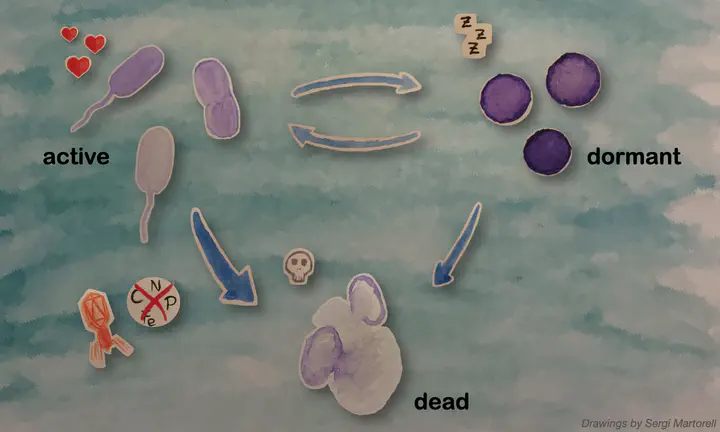 Image by Sergi Martorell
Marine prokaryotic communities play central roles in the oceans ecosystems functioning and in the oceans resilience to global change. These communities are extremely diverse in terms of taxonomy, metabolic capabilities, and activities, and show a remarkable ability to persist from months to years when facing unfavorable conditions by becoming dormant (a reversible state of low metabolic activity). Despite more than 40% of the prokaryotic cells in the ocean may be found in a dormant state, the growth-arrest response leading to dormancy and associated strategies for survival have been barely explored in marine prokaryotes, and most of the knowledge we have derive from clinical isolates. Dormancy generates a seed bank, i.e. a reservoir of dormant individuals that can resuscitate upon favorable conditions. Seed banks are central for the long-term maintenance of diversity and ecosystem function because they determine how communities recover from perturbations and potentially stabilize ecosystem processes subjected to change. CROSS-POINT aims at generating knowledge on how cells transition into a dormant state by exploring the molecular basis of dormancy in marine metagenomes, and evaluating survival strategies in ecologically relevant marine isolates. For this purpose, CROSS-POINT will use a multifaceted approach that combines metagenomics, single-cell approaches, transcriptomics, and proteomics.